"These tiny stars," reports Ashley Strickland of CNN News, "along with brown dwarfs, are long-lived, common in the Milky Way and represent 25-50% of stellar objects in the galaxy, said study researcher Julien de Wit, a postdoctoral associate with MIT's Department of Earth, Atmospheric and Planetary Sciences. They were largely overlooked until researcher Michaël Gillon of the University of Liège in Belgium decided to take a risk and study the space around one of these dwarves. It paid off: over the course of 62 nights from September to December 2015, researchers led by Gillon used a telescope, also called TRAPPIST (transiting planets and planetesimals small telescope), to observe its starlight and changes in brightness. The team saw shadows, like little eclipses, periodically interrupting the steady pattern of starlight. Using a telescope that can detect infrared light added an advantage that visible light camera programs don't provide.
'It's
like standing in front of a lamp and throwing a flea across it,' said
professor Adam Burgasser of the Center for Astrophysics and Space
Science at the University of California San Diego. 'It was only a 1% dip
in light, but the specific pattern was a good sign of orbiting
planets.'"
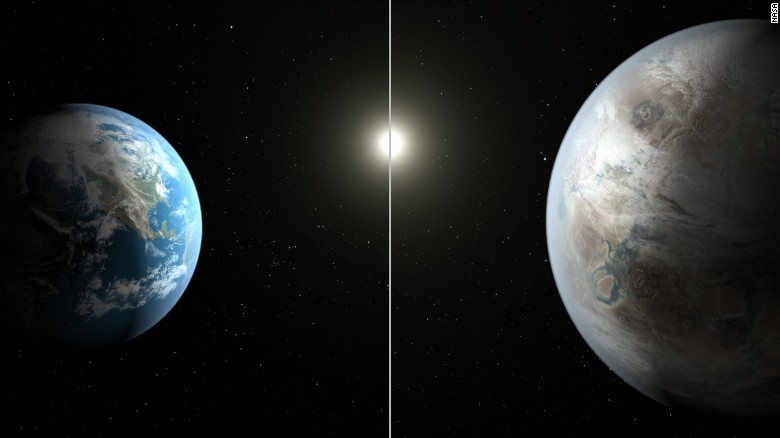
Strickland also analyzed that though we've taken a huge step forward with this discovery, we still have plenty of time before we get even close to finding out some of the mysteries of these planets. She commented, "The planets are the perfect target to be studied at 40 light-years away, but that doesn't mean we will reach them anytime soon. With current technology, it would take millions of years for an expedition to reach these planets. But from a research perspective, they provide a close opportunity and the best target to search for life beyond Earth and our solar system. What we find also could change how we determine the creation of life as we know it. The telescopes these researchers use to study the planets are even more precise than Hubble. In 2018, they can begin using the James Webb Space Telescope, which will allow the scientists to observe the shell of an atmosphere if it exists for these planets, and even what chemicals comprise that atmosphere. It will also provide more detailed information about the planets' composition, temperature and pressure, according to de Wit."
This article can be synthesized with the discovery of the New World (America) by Vikings, Native American descendants, and lastly Christopher Columbus in 1492. This discovery often created scorn and disbelief until proven upon visiting and bringing back trade. Similarly with space exploration, it can be difficult to believe in such a thing as extra-terrestrial life or even another planet capable of supporting it, but through extensive research and numerous years worth of technology advancements, perhaps in a coming age we will be able to visit these planets. If we do, what then?
Article can be found here: http://www.cnn.com/2016/05/02/health/three-habitable-planets-earth-dwarf-star/index.html

I think this is a great scientific discovery! I hope people don't take this planet for granted because a new planet is available.
ReplyDeleteBella Di Fazio 8th
Matthew Homsher 9th- They make a good point in the article about it being too far away. We don't even have technology to take us one light year, much less 40. It's good that we have the information, should we ever gain the technology, but it's a little early to consider colonizing planets.
ReplyDeleteWe should not start colonizing planets at all with humans. If there is a planet that can be used, lots of research and planting should be done before humans or sentient life is ever thought about.
ReplyDelete